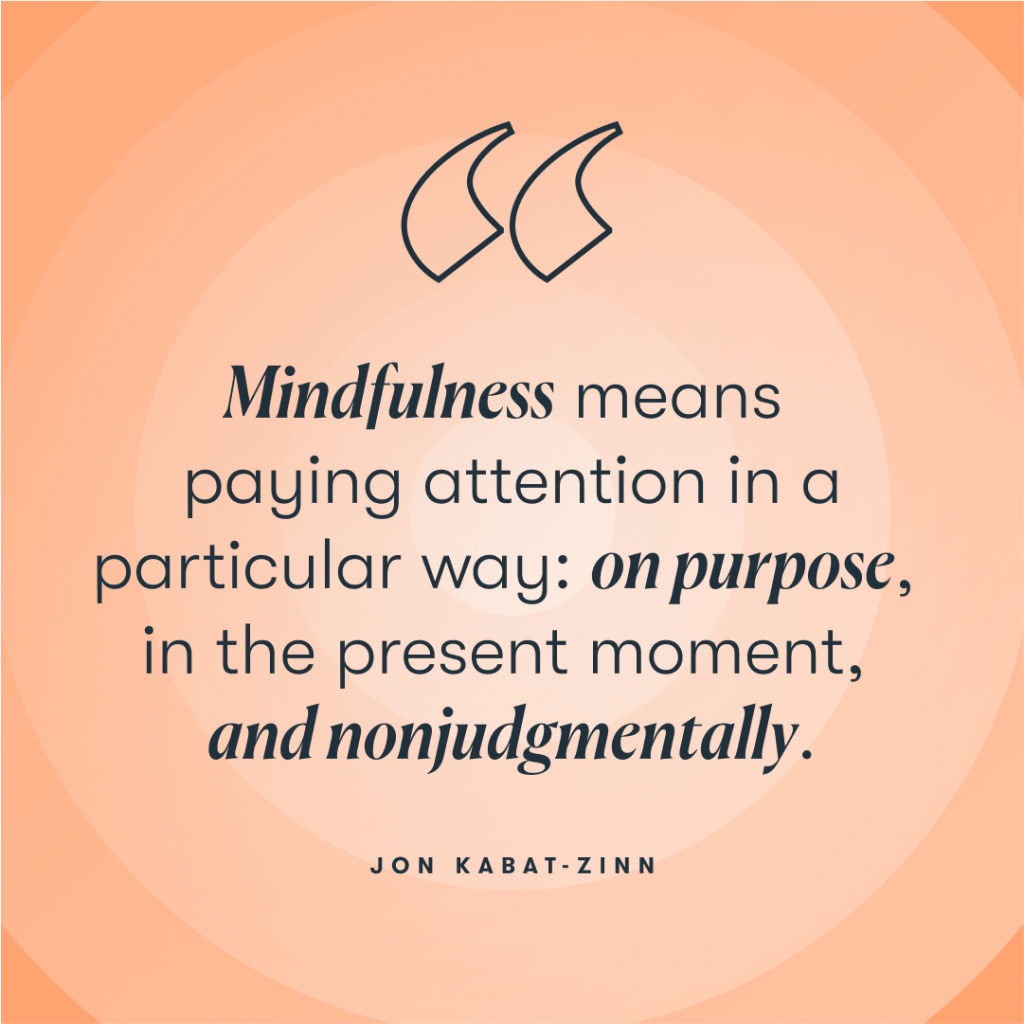
The quote above is my favorite definition of mindfulness and the one I use when explaining mindfulness to my clients. The first time it was suggested that I use mindfulness for pain management, I was post-running-injury, pre-second-fusion-surgery, when not having the right medications in my system or not being positioned just right in bed put me in the worst pain of my life. I was on a Zoom therapy call when my very well-intentioned therapist brought up that mindfulness-based practices have been found clinically effective in reducing physical pain. I think I responded with something along the lines of, “Thanks, but I’m going to keep taking my oxycodone for now.” To me, my pain was in my herniated discs and pinched nerves. There was no way that focusing on my breath or trying to clear my mind could possibly change that.
But my therapist wasn’t wrong. There’s a lot of research that confirms that mindfulness practice reduces reported intensity and unpleasantness of pain through multiple mechanisms in our brain, as confirmed by brain imaging (Zeidan & Vago, 2016). One study found that after just one week of 30-minute-a-day practice, new mindfulness practitioners reported less intensity of pain when compared to the control group. Additionally, increased time practicing mindfulness led to reductions in the reported unpleasantness of pain (Zeidan & Vago, 2016). But like, how???
In doing research on mindfulness for this post, I found references to the “Sallatha Sutta,” a Buddhist script meaning “the arrow.” I wanted to include it here for two reasons – 1. to respect and acknowledge that mindfulness practices originate in Buddhist teachings and 2. because it helps explains the concepts. This is a portion of the translated text, provided by John Haspel (2023):
When, through the six-sense base, an uninformed person experiences a feeling of pain they are sorrowful, they grieve, they become distraught and irate. The uninformed feels two pains: the physical pain of the experience and the mental pain caused by the reaction arising from clinging (to views ignorant of Four Noble Truths). This would be like being hit with an arrow and then, by request, being hit again by another arrow.
From my (western and secular) understanding, this text suggests that it is often not the experience itself that bothers us most, but rather the meaning we give to the experience. Hello therapy lingo, this is something I can wrap my head around! The teaching continues:
Sensing pleasure or pain, or neither pleasure nor pain, the uninformed (through self-reference or personalizing the experience) joins with it. The uninformed is joined to birth, aging, sickness, and death, and joined with sorrows, grief, pain, and despair. Through reaction to the experience, the uninformed joins with further confusion and suffering… The well-informed person, when stress arises, has no resistance. With no resistance, no resistance-obsession is formed. They feel one pain – physical – but not mental. Just as if they were shot with an arrow but not another, they would feel only one pain – the physical pain (Haspel, 2023).
This is backed up by modern research, which has found through brain imaging that participants who practiced mindfulness experienced a “decoupling of sensory and affective pain” (Zeidan & Vago, 2016). For me personally, I am very familiar with the two arros of pain. How many times have I noticed a twinge in my back or legs and had the thought, “The last time I felt like this, I couldn’t move for two weeks. That was such a scary experience” or perhaps, “I hate that I’m having this pain. What if it gets worse and I’m in a wheelchair by the time I’m 45?” And then I become overwhelmed with uncomfortable emotions from the meaning I am giving to the pain, not the pain itself.
So in the context of physical pain, I think of mindfulness as paying attention and being in tune with my body, with the intention to find healing, while maintaining a non-judgmental attitude about what the pain could mean. This is tricky, much easier said than done, and probably true only in moderation. Because of course, pain is information, a potential warning sign, and important to keep track of to be a self-advocate in our healthcare system. And, in moments of new or significantly worsening pain, I’m not suggesting that the best course of action is to think, “It’s probably just my bones pinching my nerves, it’ll be fine.” But as someone with daily pain with a known cause, having a strong emotional reaction to it every single time is just not helpful. My intention this week is, in moments when I am hurting, to validate the pain, notice it and document it if I want to bring it up to my physical therapist later, but also to gently remind myself not to get caught up in a story about what my pain could potentially mean. This requires staying in the present moment, rather than jumping to the past or the future. Which is hard, uncomfortable, and takes time and practice, especially when you’re as skilled at catastrophizing as I am. But just like muscle memory gets better with time and repetition, so too does mindset. I’ll let you know how that goes next week.
References
Haspel, J. (2023). The Sallatha Sutta – The Two Arrows. Becoming Buddha. https://becoming-buddha.com/sallatha-sutta-the-two-arrows/.
Zeidan, F. & Vago, D. (2016). Mindfulness meditation-based pain relief: a mechanistic account. Ann NY Acad Sci. 2016 Jun 1373(1): 114-127. doi 10.1111/nyas.13153


 Living Spinefully
Leave a comment