So to give you a little bit of context, I’ll share my scoliosis story, thus far. I was diagnosed with congenital scoliosis during a prenatal ultrasound, and have known I have scoliosis for as far back as I can remember. Congenital scoliosis occurs due to malformations of the vertebrae themselves, which then become more crooked with growth. This differs from idiopathic scoliosis, when normal vertebrae become crooked for no apparent reason. As a young child, doctor’s visits with routine x-rays were somewhat of a special occasion for alone time with mom in a family of 4 children. When I was 10, I started experiencing more frequent back pain and had to modify activities around sitting unsupported, walking long distances, or riding in the car. At my yearly x-ray in July of 2008, one month after my 11th birthday, it was determined that the largest curve in my lower thoracic spine, which had held fairly constant at around 30 degrees for most of my life, had worsened to 67 degrees, far surpassing the threshold for surgical intervention. My surgery was scheduled for November of that year. In the months beforehand, my pain and worries progressively got worse. Fears of having to miss school, explaining the surgery to my classmates, wearing a brace afterwards, and having a scar consistently left me in a puddle of tears. I was successfully fused T3-L4 on November 20, 2008. I received many supportive gifts and cards from classmates, my family, and my youth group. I came home from the hospital on December 1st and was able to go back to school in a brace in January. By about May of 2009, I felt mostly recovered. I was cleared from basically all restrictions and was given little information about what my now fused spine could and could not do. I started middle school that fall and scoliosis quickly returned to being a random piece of personal trivia that rarely crossed my mind.
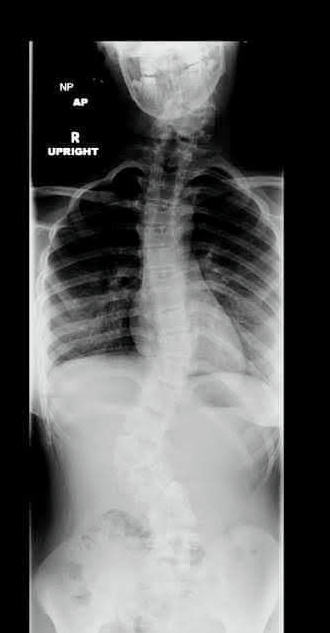
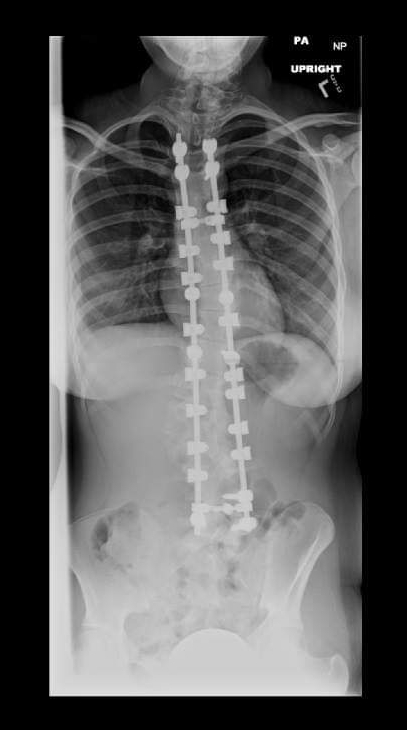
Throughout high school and college, scoliosis remained primarily on the back burner. I went for yearly routine x-rays, where I was told repeatedly that everything was normal and to keep a strong core. I noticed my anniversary every November, and tried to commemorate it with some kind of physical activity to celebrate the strength of my body. I became a casual runner in high school and loved how invigorated running made me feel. I felt like I had beaten scoliosis. I studied abroad in Cusco, Peru my senior year of college, and spent the 10 year anniversary of my surgery hiking in the Andes. Returning from a semester living at over 11,000 feet, I noticed how strong my lungs were and decided to start running more seriously. I loved distance running – the challenge, the thrill of beating my fastest times, the achievement of running a new longest distance. I completed a half marathon in May of 2019 and began to identify as a runner – really, the only sport I had ever been decent at. I graduated with my masters degree in social work in May 2020 and started working as a mental health therapist for adolescents in Columbus. That fall, I began training for another half marathon scheduled for April of 2021. My work was stressful, the pandemic was stressful, my family life was stressful, and running provided such an escape from it all – as if I could actually outrun all my problems. Scoliosis was so far down the list of things that worried me.
In December of 2020, while visiting my parents in Dayton for Christmas, I went on a standard run on a familiar route. I noticed that I felt a little stiff the next day, but chalked it up to not stretching enough, and drove back to Columbus for work as planned. I was shocked to wake up the next morning, barely able to move. Lying on my side, sitting, or standing up all left me winded from the pain, with chattering teeth and nausea. I had shooting pain down my leg, and discovered I couldn’t move my toes or my ankle on my right side with nearly the dexterity I could on my left. After a day of worsening symptoms, my mom rushed to my Columbus apartment and I rode lying flat in the back seat of her car to an urgent appointment with my former orthopedic surgeon (at Dayton Children’s, despite being 23 at the time). An MRI confirmed that through the impact of distace running, with minimal shock absorption in the fused part of my spine, the disc underneath my fusion had herniated, with severe nerve impingement, causing the motor deficits and pain. I was scheduled for surgery a week later. Everything happened so quickly, that to be honest, it’s still hard for me to process. I went from running my fastest 10k time the first week of December, to being flat on my back in the worst pain of my life a month later. On January 8, 2021, I had surgery to decompress the nerve and fuse the remaining unfused vertebrae, L4-S1, with two screws in my hips, securing my spine to my pelvis.
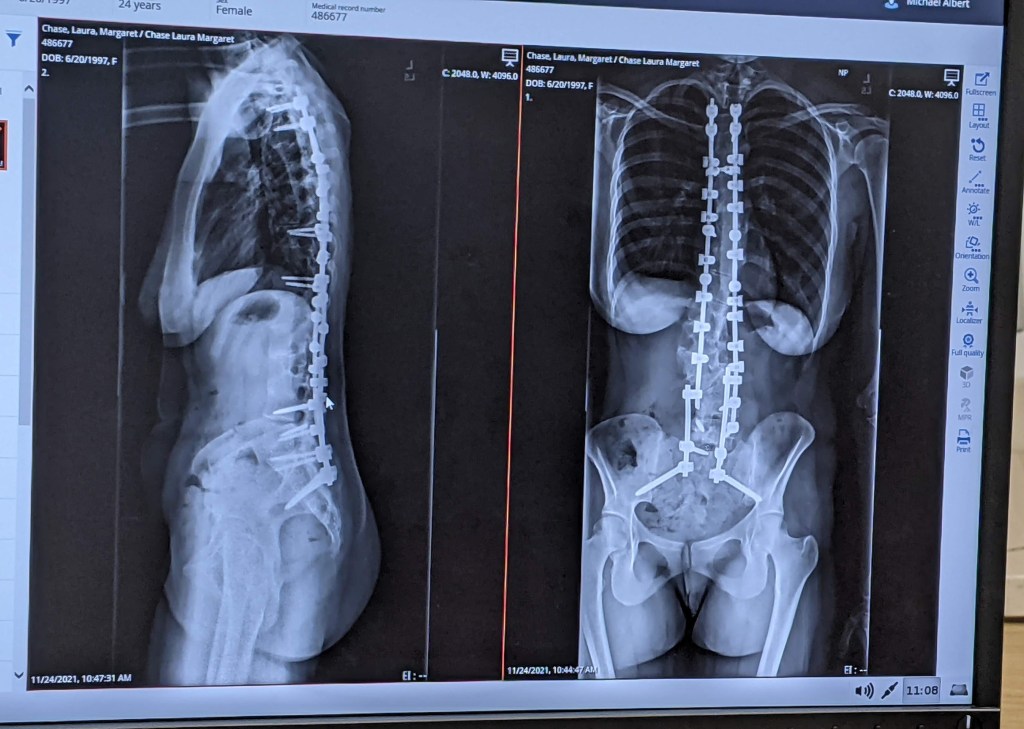
Bouncing back took a little longer than it did the first time. The nerve damage took a while to heal, meaning that I walked with a significant limp for months. I was told that I should never return to distance running, as the impact is just too much on my fused spine. Grieving running has been a process, and I can’t say that I don’t ache for it and for that version of my body at times. Around 9 months ago, my pain began to very gradually worsen. After seeking second and third opinions, it has been determined that the fusion did not heal fully, and that one of the screws in my hips is loosening and pressing up against a nerve, causing the increased pain in my hips and legs. I literally have a screw coming loose. Another surgery is an option, but there’s no guarantee it will resolve the pain. Today, I take a handful of pills everyday for pain relief. I do weekly physically therapy and try my best to remember to stretch and go for walks. So many things that I had previously taken for granted and assumed would be part of my life are total unknowns to me now. I don’t know if I’ll be able to hike a mountain again. I don’t know what pregnancy will do to my already unstable back and if I want to risk it. I don’t know how many more years of mobility I have. These worries swallow me whole at times, leading me down rabbit holes of internet searches, and lots of tears. But the truth is, no one can look into a chrystal ball and tell me the future of my spine. Living in the unknown is painful, but I remind myself that in reality, no one has a guarantee of tomorrow. All I can do is live in this moment.


 Living Spinefully
Leave a comment